
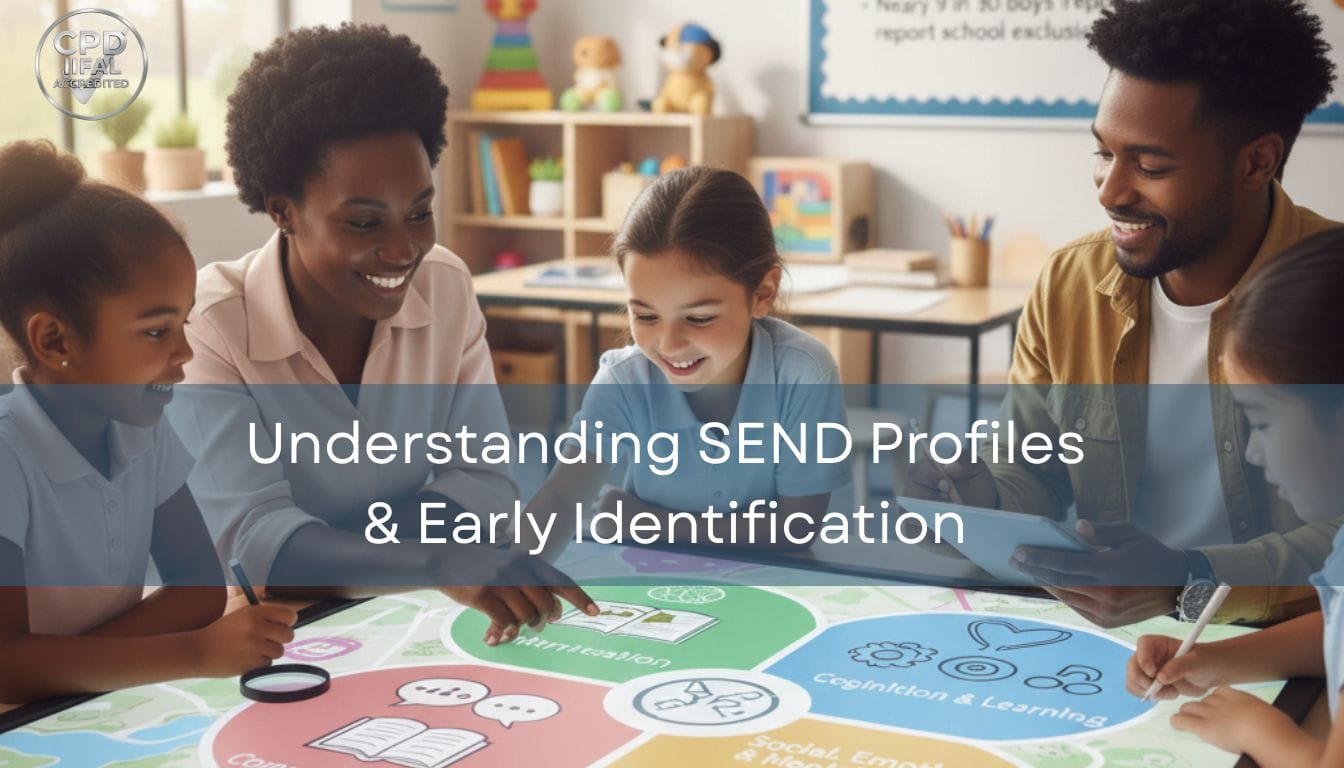
Understanding SEND Profiles & Early Identification

Wishlist Share
Share Course
Page Link
Share On Social Media

About Course

This course provides parents with a comprehensive introduction to Special Educational Needs and Disabilities (SEND), focusing on how these needs may present in everyday settings and the early signs to watch for. It equips parents with practical knowledge and tools to observe patterns, identify potential needs, and advocate for support even before a formal diagnosis is made. The course also examines the consequences of unmet or undiagnosed SEND, including emotional impact, educational disadvantage, and the risk of school exclusion, laying the foundation for the subsequent courses in the series.

By the end of the course, participants will be able to describe the four broad areas of SEND Communication & Interaction, Cognition & Learning, Social Emotional & Mental Health, and Sensory & Physical needs understand the SEND Code of Practice and parental rights, recognise early indicators of emerging needs, and distinguish between behaviour and unmet needs. Learners will also gain skills to observe and record patterns to support requests for help, take initial steps toward accessing school or GP support pathways, understand the link between unmet needs and school exclusion, and build confidence to trust their parental instincts while advocating for assessment and support.

Show More

What Will You Learn?

  • Recognise the four broad areas of SEND and their key characteristics.
  • Understand the SEND Code of Practice and parental rights.
  • Identify early signs and behaviours that may indicate emerging SEND needs.
  • Observe and record patterns to support requests for help.
  • Differentiate between behaviour and unmet needs.
  • Take initial steps toward accessing support from schools and healthcare professionals.
  • Build confidence to trust parental instinct and advocate for assessment.

Course Content

Module 1: Introduction to SEND
This module establishes a vital foundation, shifting the focus from "waiting for a label" to "acting on need." You will explore the SEND Code of Practice, learning that support is a legal right that should begin the moment a barrier is identified. By breaking down the four broad categories of need, we help you translate parental intuition into professional evidence.Key Highlights:The "Support First" Mindset: Why a diagnosis is not a prerequisite for help.The 4 Pillars of Need: Mapping behaviors to official educational categories.The Power of Advocacy: Using early identification to break the cycle of school exclusion.

  • Lesson 1.1: What is SEND? Need vs. Diagnosis
  • Learning Check
  • Lesson 1.2: The SEND Code of Practice: Essential Guide
  • The SEND Code of Practice: An Essential Guide for Parents
  • Lesson 1.3: Sensory & Physical Needs (Visual, Hearing, Physical Disabilities)
  • Activity: Recognising and Supporting Sensory & Physical Needs in Children

Module 2: Understanding SEND Profiles
Module 2: Understanding SEND Profiles introduces parents to the key characteristics and behaviours of major SEND areas, including ADHD, ASD, dyslexia, and dyspraxia. Participants will learn to recognise emotional, cognitive, social, and motor challenges, as well as common signs such as impulsivity, rigid routines, literacy difficulties, and coordination issues. Practical observation activities help map behaviours across environments, equipping parents to support their child effectively and advocate for appropriate interventions.

Module 3: Spotting Early Signs Before Diagnosis
This module helps parents identify early indicators of SEND before a formal diagnosis is made. Participants will learn to distinguish between behaviours and underlying needs, track patterns across home and school, and gather evidence to support advocacy. Early identification enables timely intervention, reducing the risk of academic struggles, emotional challenges, and school exclusion.

Module 4: Accessing Support Without a Diagnosis
Parents’ rights, documentation, and advocacy strategies to access early support. Many parents believe a formal diagnosis is required before schools or professionals can provide support—but that’s not the case. Module 4 equips parents with practical tools, strategies, and confidence to act on their child’s needs immediately. You’ll learn how to document observations, communicate effectively with professionals, and advocate for interventions, even before a diagnosis is confirmed.

Assessment & Certification
The Assessment & Certification (Graded) component of the course is designed to ensure participants not only understand key concepts but can also apply them practically. It includes a graded self-quiz, requiring a minimum score of 70%, which reinforces knowledge of early SEND signs, parental rights under the SEND Code of Practice, and the distinction between behaviour and unmet needs. Participants also complete a one-week SEND observation log, recording behaviours, triggers, context, and responses, which provides objective evidence for reflection and advocacy. Using insights from the observations, they draft a concise 1-page personal plan detailing identified needs, planned meetings, strategies, and follow-up goals. Successful completion of these assessments earns participants a CPD Certificate of Completion, recognising both their theoretical understanding and practical application of early identification and advocacy skills.

Course Resources (Downloadable)
To support your learning and practical application, participants will have access to a suite of downloadable resources designed to make observation, advocacy, and support easier and more effective.

Earn a certificate

Add this certificate to your resume to demonstrate your skills & increase your chances of getting noticed.
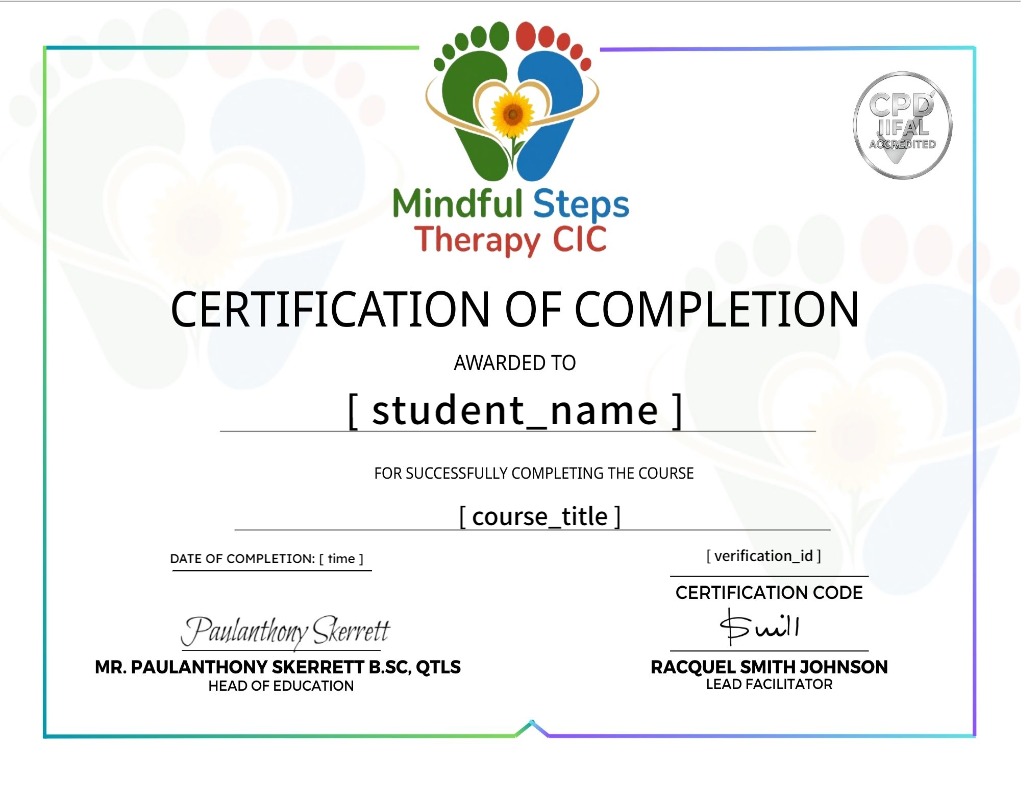
selected template

Student Ratings & Reviews

No Review Yet
No Review Yet