
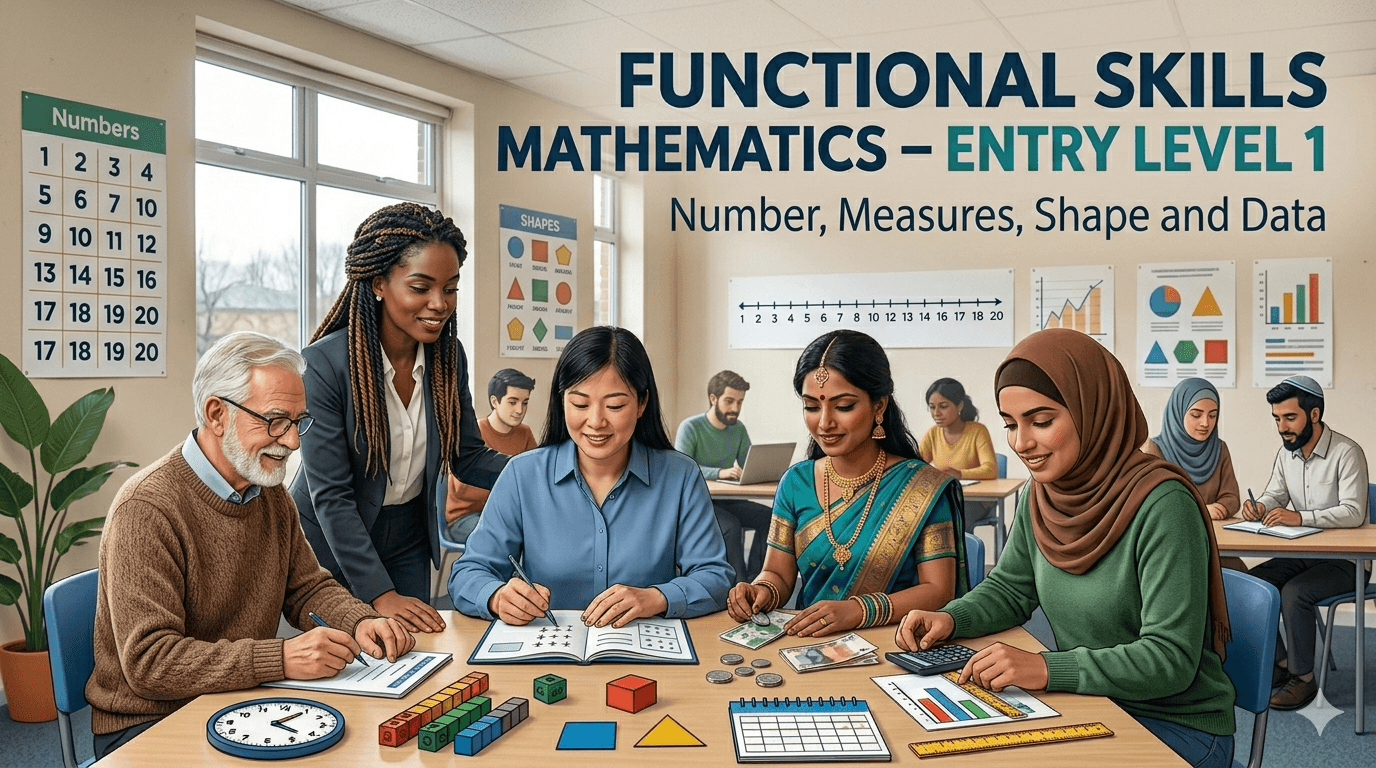
IIFAL Functional Skills Mathematics – Entry Level 1

Wishlist Share

About Course

Functional Skills Mathematics – Entry Level 1 is designed to help learners develop the essential numeracy skills needed for everyday life, work, and further learning. This course introduces basic mathematical concepts in a simple, practical, and supportive way, making it ideal for learners who are beginning their maths journey or looking to build confidence in using numbers.

Throughout the course, learners will develop skills in number recognition, counting, ordering numbers, addition, and subtraction, alongside practical mathematical skills such as using money, telling the time, understanding measures, recognising shapes, and interpreting simple data. Lessons are designed to be engaging, accessible, and relevant to real-life situations, helping learners apply maths skills in everyday tasks.

The programme focuses on building confidence and independence through step-by-step learning and practical activities. Learners will gain a strong foundation in mathematical understanding while improving problem-solving and decision-making skills that can be used at home, in the workplace, and within the community.

This qualification is suitable for adult learners, learners returning to education, and those requiring additional support in numeracy, providing a clear pathway towards Functional Skills Mathematics Entry Level 2 and further progression.

Show More

What Will You Learn?

  • Recognise and count numbers confidently from 0 to 10
  • Develop understanding of numbers up to 20
  • Order numbers correctly in sequence
  • Use basic addition and subtraction within 20
  • Recognise and use money in everyday situations
  • Tell the time to the hour on analogue clocks
  • Understand days, months and seasons
  • Compare simple measurements in real-life contexts
  • Identify common 2D and 3D shapes
  • Understand basic position and direction language
  • Interpret simple data and charts

Course Content

Numbers 0 to 10
This introductory lesson helps learners recognise, understand, and use numbers from 0 to 10 in everyday situations. It builds confidence with basic number recognition, counting objects, and understanding quantity through simple, practical examples. Learners will explore how numbers are used in daily life, such as counting items, identifying numerals, and matching numbers to quantities.By the end of the lesson, learners will be able to confidently recognise numbers 0–10, count accurately, and begin to apply basic number skills as a foundation for further Functional Skills Mathematics learning.

  • Numbers 0 to 10 – Recognising and Counting Numbers

Numbers 11 to 20 – Building Counting and Number Confidence
This module helps learners develop confidence with numbers beyond 10, focusing on recognising, counting, and sequencing numbers from 11 to 20. Learners will strengthen their understanding of number order and begin to apply counting skills in everyday contexts. The module supports progression from basic number recognition towards more complex number work required in Functional Skills Mathematics, using practical, visual, and real-life examples to reinforce learning.

Ordering Numbers – Understanding Number Sequence and Value
This module develops learners’ understanding of number order and sequence within the range of 0 to 20. Learners will build confidence in recognising which numbers are greater or smaller and how to arrange numbers correctly. Through practical and visual activities, learners will strengthen their ability to compare and sequence numbers, supporting essential skills needed for everyday problem-solving and progression in Functional Skills Mathematics Entry Level 1.

Addition to 20 – Building Early Calculation Skills
This module helps learners develop confidence with simple addition within 20. It focuses on building a clear understanding of combining numbers using practical, visual, and real-life examples. Learners will strengthen their mental maths skills, improve accuracy in basic calculations, and apply addition to everyday situations such as counting objects, money, and quantities. The module supports progression in Functional Skills Mathematics by developing essential number fluency and problem-solving skills.

Subtraction to 20 – Understanding Taking Away and Simple Difference
This module develops learners’ understanding of subtraction within 20, focusing on the concept of “taking away” and finding the difference between numbers. Through practical, visual, and real-life examples, learners will build confidence in reducing quantities and solving simple problems. The module supports the development of essential Functional Skills Mathematics knowledge, helping learners apply subtraction in everyday situations such as money, counting objects, and simple calculations.

Money Recognition – Understanding Coins, Notes and Value
This module introduces learners to the concept of money and its value in everyday life. It helps build confidence in recognising UK coins and notes, understanding their worth, and using money in simple real-life situations. Learners will develop essential Functional Skills by identifying different denominations, comparing values, and applying money skills to practical contexts such as shopping and everyday transactions.

Time – Understanding and Telling the Hour
This module introduces learners to the concept of time, focusing on how to read and understand o’clock times on analogue clocks. Learners will develop confidence in recognising the position of the hour hand and linking it to the correct hour. Through practical and visual learning activities, they will begin to understand how time is used in everyday life, such as routines, appointments, and daily schedules. The module supports progression in Functional Skills Mathematics by building essential time-reading skills.

Days, Months and Seasons – Understanding Time Cycles
This module introduces learners to the basic structure of time through days, months, and seasons. It helps learners understand how time is organised across the week, year, and seasonal changes. Using practical and everyday examples, learners will develop the ability to recognise, sequence, and relate time periods to daily life. The module supports Functional Skills Mathematics by building awareness of time patterns and real-world scheduling.

Measures Comparison – Understanding Size, Weight and Capacity
This module helps learners develop an understanding of measurement by comparing length, weight, and capacity in everyday contexts. Learners will build confidence in using simple language such as longer, shorter, heavier, lighter, more, and less. Through practical and visual activities, they will explore how measurement is used in real life situations such as shopping, cooking, and daily routines. The module supports Functional Skills Mathematics by developing essential skills in estimation, comparison, and decision-making.

Shapes in Daily Life – Recognising 2D and 3D Shapes
This module helps learners identify and understand common 2D and 3D shapes found in everyday environments. Learners will build confidence in recognising shapes such as circles, squares, triangles, cubes, and spheres, and relate them to real-life objects. Through visual and practical examples, learners will develop spatial awareness and begin to understand how shapes are used in homes, workplaces, and daily surroundings. The module supports Functional Skills Mathematics by strengthening observation, recognition, and classification skills.

Position and Direction – Understanding Location, Movement and Space
This module helps learners develop an understanding of position and direction in everyday contexts. Learners will explore basic spatial language such as left, right, forwards, backwards, above, below, near, and far. Through practical and visual activities, they will build confidence in describing movement and locating objects in space. The module supports Functional Skills Mathematics by developing essential spatial awareness and communication skills used in daily life.

Data Handling – Understanding Simple Information and Charts
This module introduces learners to the basics of data handling using simple tables, pictograms, and charts. Learners will develop the ability to collect, organise, and interpret straightforward information. Through practical and visual examples, they will build confidence in understanding data in everyday contexts such as surveys, counting, and comparing information. The module supports Functional Skills Mathematics by developing essential skills in observation, interpretation, and basic analysis of data.

Functional Skills Maths Entry Level 1 – Full Assessment (A & B)
This timed assessment evaluates learners’ foundational maths skills at Entry Level 1 across both non-calculator and calculator sections. It assesses number recognition, counting, simple addition and subtraction, and interpreting basic information such as charts, lists, money, time, measures, shapes, and data. The assessment also develops learners’ ability to apply basic calculator skills where appropriate and demonstrate independent working in everyday mathematical contexts.

Earn a certificate

Add this certificate to your resume to demonstrate your skills & increase your chances of getting noticed.
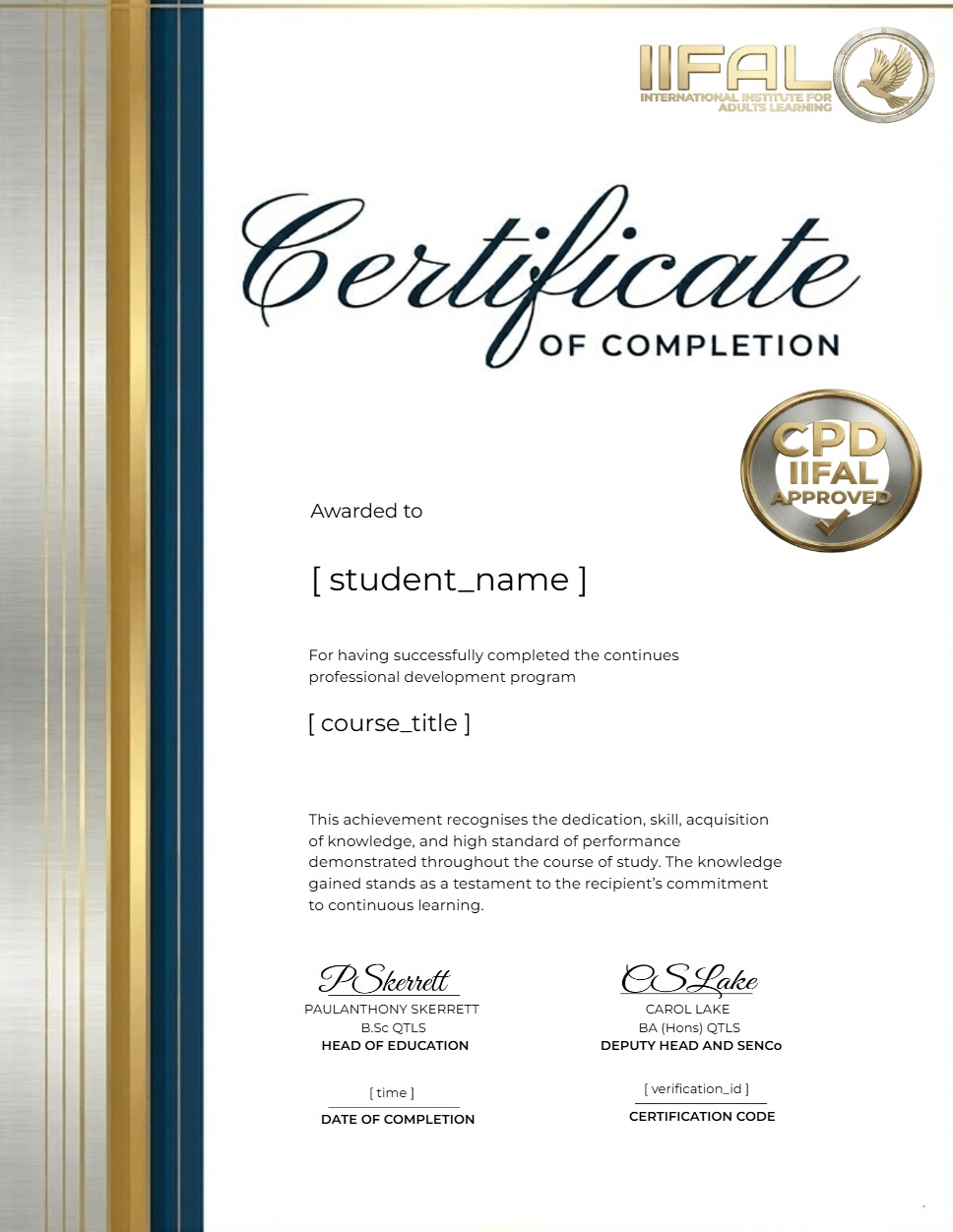
selected template

Student Ratings & Reviews

No Review Yet
No Review Yet