

IIFAL Functional Skills Maths – Level 2

Wishlist Share

About Course

The IIFAL Functional Skills Mathematics – Level 2 course is designed to develop confident, independent, and practical mathematical skills that can be applied in real-life and workplace contexts. This qualification supports learners in building a strong command of essential mathematical concepts, enabling them to solve problems, interpret information, and make informed decisions using numerical reasoning.

Throughout the course, learners will develop fluency in number operations, fractions, decimals, percentages, ratio, proportion, algebra, measures, geometry, data analysis, and probability. The programme places a strong emphasis on problem-solving, critical thinking, and the ability to apply mathematics in unfamiliar situations.

Learners will be prepared for the externally assessed Functional Skills Mathematics Level 2 examination, which is equivalent in demand to a GCSE Grade 4/5. The assessment requires learners to demonstrate both non-calculator and calculator-based skills in a single sitting, testing accuracy, reasoning, and application.

By the end of the course, learners will be able to confidently:

  • Apply mathematical skills in everyday and professional settings
  • Solve multi-step problems with clarity and accuracy
  • Interpret and analyse data effectively
  • Use algebraic and numerical methods with confidence
  • Demonstrate logical thinking and mathematical reasoning

The IIFAL Functional Skills Mathematics – Level 2 course is ideal for adult learners seeking to improve employability, progress into further education, or strengthen essential life skills in mathematics.

Show More

What Will You Learn?

  • Apply mathematical skills confidently in everyday and workplace contexts
  • Solve multi-step problems using structured reasoning and clear methods
  • Interpret and analyse data presented in tables, charts, and graphs
  • Use fractions, decimals, percentages, ratio, and proportion effectively
  • Work with algebraic expressions, formulae, and equations in practical situations
  • Calculate and interpret measurements, geometry, and spatial problems
  • Understand and apply probability and statistical reasoning in real scenarios

Course Content

Module 1: Number Skills and Order of Operations
This module develops core numerical fluency, focusing on working confidently with integers, decimals, and calculations involving multiple steps. Learners develop understanding of BIDMAS/BODMAS and apply the correct order of operations in structured problems. Emphasis is placed on accuracy, estimation, and checking strategies to ensure reliable answers. Learners also build confidence working with large numbers and indices in practical contexts. By the end of the module, learners will be able to complete multi-step calculations accurately and apply logical sequencing to mathematical problems encountered in everyday and workplace scenarios.

  • Mastering Number Operations and Order of Calculation

Module 2: Fractions, Decimals, and Percentages
This module focuses on building strong understanding of equivalence and conversion between fractions, decimals, and percentages. Learners develop fluency in calculating with all three forms and applying them to real-life contexts such as money, discounts, and data interpretation. The module includes percentage change, reverse percentages, and fractional operations. Learners strengthen their ability to move flexibly between representations and choose the most efficient method for problem solving. By the end, learners will confidently apply FDP skills in practical and exam-based scenarios.

Module 3: Ratio and Proportion
This module develops proportional reasoning skills, enabling learners to compare quantities and solve real-world scaling problems. Topics include simplifying ratios, dividing quantities, and applying direct and inverse proportion. Learners explore how proportional relationships are used in everyday contexts such as recipes, maps, and business calculations. The module builds logical thinking and structured problem-solving approaches. By the end, learners will confidently interpret and apply ratio and proportion in both mathematical and practical situations.

Module 4: Algebra and Formulae
This module introduces learners to algebraic thinking, including the use of variables, expressions, and formulae. Learners develop skills in substitution, simplification, and solving basic equations. The module also explores how formulae are used in real-world contexts such as finance, science, and measurement. Emphasis is placed on interpreting relationships between variables and manipulating formulae to find unknown values. By the end, learners will be able to confidently use algebra as a tool for problem solving and reasoning.

Module 5: Measures and Conversions
This module focuses on accurate measurement and unit conversion across metric and imperial systems. Learners develop skills in converting length, weight, capacity, and time, and applying these in practical scenarios. Estimation and checking strategies are reinforced to ensure accuracy. Real-world applications such as construction, travel, and cooking are used to support understanding. By the end, learners will confidently interpret and convert measurements in everyday and workplace contexts.

Module 6: Perimeter, Area, and Circles
This module develops understanding of two-dimensional geometry, including perimeter, area, and circle calculations. Learners apply formulas to regular and composite shapes and develop problem-solving strategies for breaking down complex diagrams. The module includes circumference and area of circles using π. Real-life applications such as flooring, fencing, and design are included. By the end, learners will confidently solve geometric problems involving shape and space.

Module 7: Volume and Surface Area
This module focuses on three-dimensional shapes and the calculation of volume and surface area. Learners explore cubes, cuboids, cylinders, and composite solids. The module develops spatial awareness and formula application in practical contexts such as packaging and storage. Learners also interpret nets and 3D diagrams. By the end, learners will confidently calculate and apply volume and surface area in real-world scenarios.

Module 8: Compound Measures in the Real World
This module introduces compound measures such as speed, density, and unit pricing. Learners develop skills in interpreting and applying rates involving multiple units. The module emphasises rearranging formulae and solving multi-step contextual problems. Real-world applications include transport, science, and finance. By the end, learners will confidently work with compound measures and apply them to practical decision-making.

Module 9: Shape, Space, and Geometry
This module develops understanding of geometric properties, angles, bearings, symmetry, and transformations. Learners explore how shapes behave in different contexts and apply spatial reasoning to solve problems. The module includes scale drawings, coordinates, and 3D interpretation. Real-world links include navigation, design, and architecture. By the end, learners will confidently apply geometric reasoning in both abstract and practical situations.

Module 10: Mastering Data Analysis
This module focuses on collecting, representing, and interpreting data using charts, graphs, and tables. Learners develop skills in calculating averages and analysing trends. The module includes interpretation of scatter graphs and comparison of data sets. Real-world applications include surveys, business data, and research. By the end, learners will confidently analyse and communicate data findings.

Module 11: Probability and Statistics
This module introduces probability concepts and statistical reasoning. Learners explore simple and combined probability events and interpret outcomes in real-life contexts. The module also reinforces statistical measures such as averages and distribution. Practical applications include risk assessment and decision-making. By the end, learners will confidently apply probability and statistics to everyday situations.

Module 12: Integrated Problem Solving
This final module brings together all mathematical strands into complex, real-world problem-solving tasks. Learners apply number, algebra, geometry, data, and probability skills in unfamiliar contexts. The focus is on reasoning, method selection, and clear justification of answers. The module prepares learners for Functional Skills assessment by developing independence and confidence. By the end, learners will be fully prepared to tackle multi-step, integrated mathematical problems.

Earn a certificate

Add this certificate to your resume to demonstrate your skills & increase your chances of getting noticed.
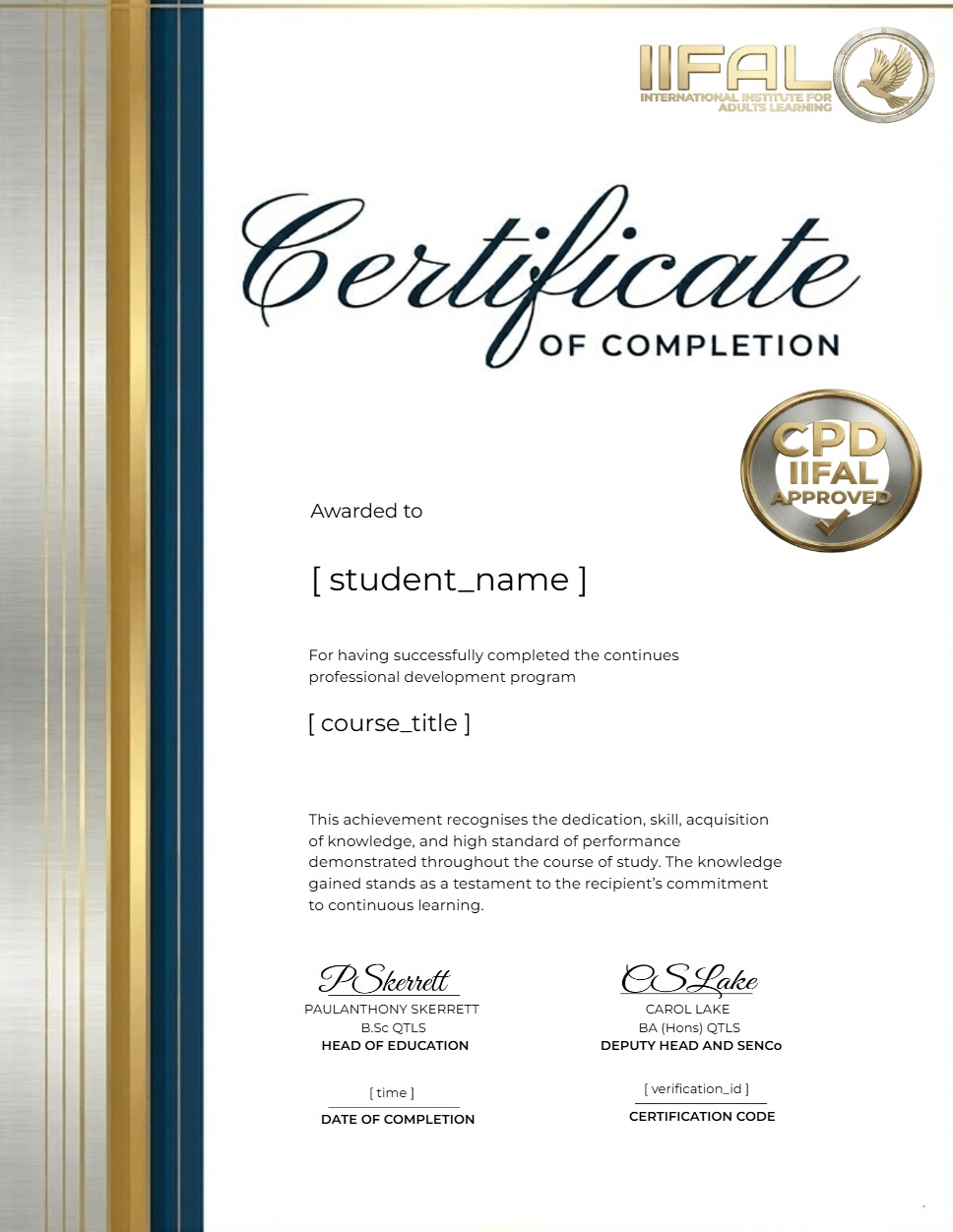
selected template

Student Ratings & Reviews

No Review Yet
No Review Yet