


About Course
Allergies can be life-threatening, and around one in five children with an allergy have their first reaction at school. Everyone who works with children needs to recognise an allergic reaction, act fast in an emergency and help prevent reactions in the first place.
This self-paced course gives teachers, teaching assistants, support staff, youth workers and others working with children and young people the knowledge to understand allergies, recognise anaphylaxis, respond correctly and support pupils who live with allergies. It is built around Benedict’s Law and the Department for Education’s statutory guidance Allergy safety in schools (July 2026), which applies to schools in England from September 2026.
What you will learn
- What allergies are, the conditions they include and the 14 key food allergens
- How to recognise allergic reactions and anaphylaxis, including when there is no rash
- What Benedict’s Law requires, and the difference between legal duties and guidance
- Exactly what to do in an emergency, including giving adrenaline within five minutes
- How adrenaline pens and the adrenaline nasal spray work, and how spare devices are managed
- How to read and use an Individual Healthcare Plan and an Allergy Action Plan
- How to reduce risk in class, at mealtimes, in PE and on trips without excluding pupils
- How to record and report incidents and near misses, and learn from them
Course structure
- Module 1: Understanding Allergies and Allergic Conditions
- Module 2: Recognising Allergic Reactions and Anaphylaxis
- Module 3: Benedict’s Law and Allergy Safety Responsibilities
- Module 4: Emergency Response and Managing Anaphylaxis
- Module 5: Adrenaline Devices and Emergency Medication
- Module 6: Individual Healthcare Plans and Allergy Risk Management
- Module 7: Creating an Allergy-Aware Educational Environment
- Module 8: Incident Reporting, Recording and Continuous Improvement
- Final Course Assessment
How you are assessed
Each module ends with a Module Knowledge Check. These are for learning only: you can take them as many times as you like, with no time limit. The Final Course Assessment decides whether you pass. You need 70% to pass and you have three attempts. When you pass, you receive an IIFAL CPD Certificate.
Important to know
This is an awareness and CPD course. It does not replace your setting’s own allergy safety policy, school-specific training or hands-on practice with adrenaline trainer devices, and the certificate does not show practical competence in giving adrenaline. The legal content applies to England; if you work elsewhere, follow the law and guidance where you work, and call your local emergency number.
Developed and quality-assured by IIFAL. Clinically reviewed by Marcia Elizabeth Roberts, Registered Nurse. With thanks to Ms Cecile Simpson, retired PGMDE Office Manager, King’s College Hospital, for reviewing the course content.
Course Content
Welcome and Course Overview
Welcome to the Course
Module 1: Understanding Allergies and Allergic Conditions
Module 2: Recognising Allergic Reactions and Anaphylaxis
Module 3: Benedict’s Law and Allergy Safety Responsibilities
Module 4: Emergency Response and Managing Anaphylaxis
Module 5: Adrenaline Devices and Emergency Medication
Module 6: Individual Healthcare Plans and Allergy Risk Management
Module 7: Creating an Allergy-Aware Educational Environment
Module 8: Incident Reporting, Recording and Continuous Improvement
Course Conclusion and Final Assessment
Earn a certificate
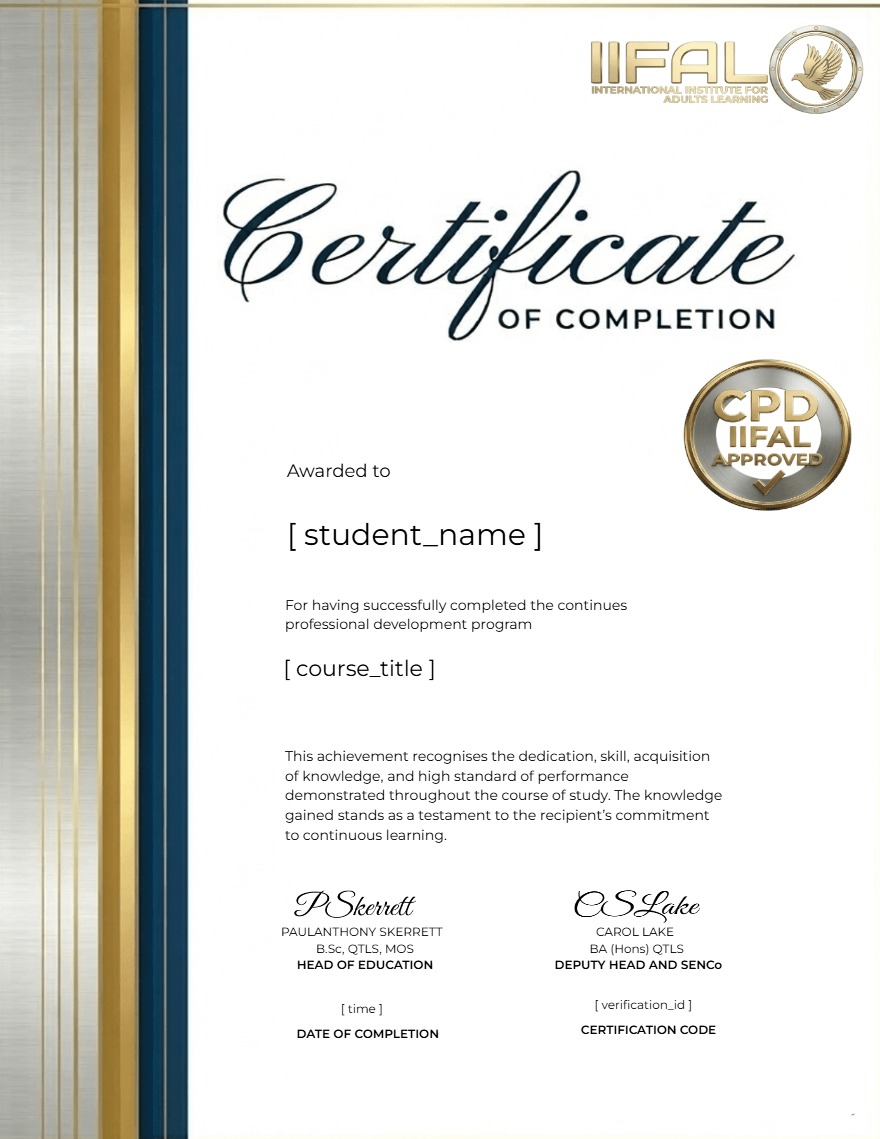
Add this certificate to your resume to demonstrate your skills & increase your chances of getting noticed.
Student Ratings & Reviews
