
Creating Inclusive Learning Environments for Young Children

Wishlist Share

About Course

This CPD certified course is designed to support early years practitioners and support staff in creating inclusive learning environments where every child feels valued, safe and supported.

The course explores the principles of inclusion, children’s rights and relevant legislation, including the UN Convention on the Rights of the Child (UNCRC) and the Equality Act 2010, and how these inform everyday practice in early childhood settings. You will develop practical skills to identify and remove barriers to inclusion, support diverse needs including SEND and EAL, and promote positive behaviour through inclusive, child-centred and trauma-informed approaches.

The course also emphasises working in partnership with parents and carers, and using reflective practice to keep improving. By the end, you will have completed your own Inclusive Action Plan and be equipped to create welcoming, engaging environments that promote equality, wellbeing and positive outcomes for all children.

How the course works

  • 6 modules and 20 lessons, with video, case studies and reflection prompts
  • 10 interactive activities, including decision-making scenarios, sorting exercises and recall cards
  • Inclusive Action Plan template to complete for your own setting
  • Study time: about 4 hours 30 minutes, at your own pace

Assessment and certificate

  • Module practice checks have no pass mark. You can retake them as often as you like, and your scores do not count towards your result. Each one needs to be submitted once to mark the module as finished.
  • The final assessment covers all six modules. You need 70% to pass and you have three attempts in total.
  • Passing the final assessment completes the course and makes you eligible for your certificate.
Show More

What Will You Learn?

  • Define inclusion and understand its principles in early years settings
  • Explain how children's rights and equality law shape inclusive practice
  • Recognise and address barriers to learning, including for children with SEND and EAL
  • Apply practical strategies to create inclusive, sensory-aware rooms and routines
  • Support positive behaviour using trauma-informed, child-centred approaches
  • Build strong partnerships with parents and carers from diverse backgrounds
  • Reflect on personal biases and embed inclusive values in daily practice
  • Develop an Inclusive Action Plan tailored to your own setting

Course Content

Module 1: Understanding Inclusion in Early Childhood Education
This module introduces what inclusion means in early years settings and the principles behind it. You will look at children's rights under the UN Convention on the Rights of the Child (UNCRC), equality law such as the Equality Act 2010, and how these shape everyday practice. You will also see why inclusive environments benefit every child, not only those with additional needs.

  • Lesson 1.1: Definitions and Principles of Inclusion
    01:54
  • Lesson 1.2: Children’s Rights and the Law: the UNCRC and the Equality Act
    02:03
  • Lesson 1.3: Why Inclusion Benefits Every Child
    00:00
  • Module 1 Practice Check

Module 2: Recognising Barriers to Inclusion
Barriers to inclusion can come from developmental delays and SEND, language differences, culture and family circumstances, and from the unconscious assumptions adults bring. This module helps you recognise these barriers, which is the first step towards removing them.

Module 3: Practical Strategies for Inclusion
This module turns principles into practice: designing rooms that are accessible and sensory-aware, differentiating activities and using adaptive resources, and choosing stories, songs and images that help every child feel they belong.

Module 4: Supporting Positive Behaviour
Behaviour is often a child's way of communicating a need or feeling. This module explores how to respond to the need behind the behaviour, how trauma-informed approaches help children feel safe, and how to create emotionally safe spaces where children can learn to manage their feelings.

Module 5: Partnership with Parents and Carers
Families are a child's first and most important educators. This module covers building trust and mutual respect, engaging families from all backgrounds, and communicating in ways that are clear, respectful and two-way, including when conversations are difficult.

Module 6: Reflective Practice and Professional Growth
Inclusion is an ongoing journey. In this module you will examine your own biases and assumptions, carry out an inclusive self-audit, set measurable goals for improvement, and complete your own Inclusive Action Plan for your setting.

Final Assessment
Read how the final assessment works, then take it. It covers all six modules. You need 70% to pass and have three attempts in total. Passing completes the course and makes you eligible for your certificate. After you finish, we would welcome your feedback on the course.

Earn a certificate

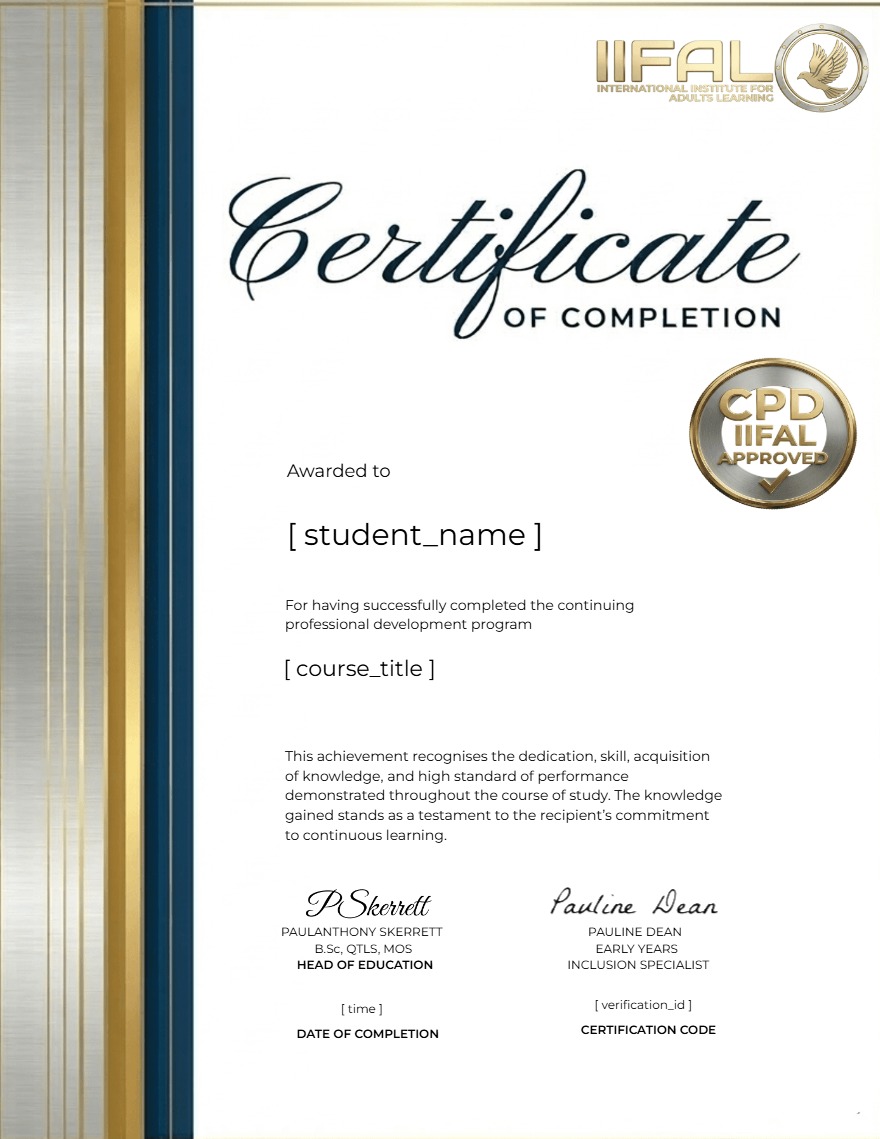
Add this certificate to your resume to demonstrate your skills & increase your chances of getting noticed.
selected template

Student Ratings & Reviews

No Review Yet
No Review Yet

Want to receive push notifications for all major on-site activities?

✕